

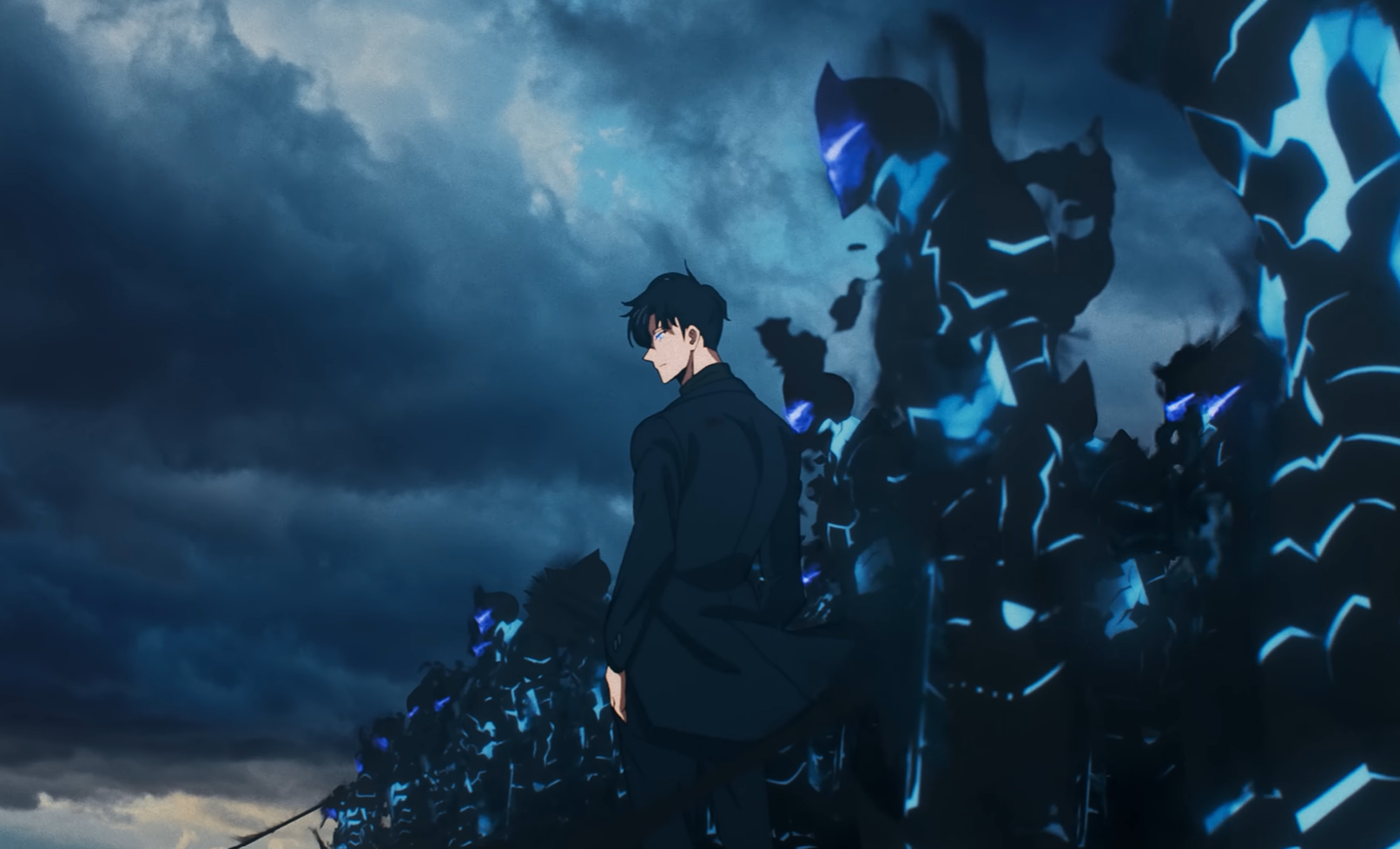
On September 8, 2026, Aniplex and Crunchyroll released a striking new key visual for Solo Leveling: Beyond the System — the upcoming theatrical anime film continuing Sung Jinwoo’s story after Season 2. The image shows Jinwoo in a commanding new form, sustaining promotional momentum for the franchise roughly nine weeks after film announced at Anime Expo on July 3. A-1 Pictures is once again animating the project, with Aniplex, Netmarble, D&C MEDIA, Kakao Piccoma, and Crunchyroll co-producing. No theatrical release date has been confirmed; a 2027 window has been widely speculated but remains officially unannounced.
The news peg is a visual. The deeper story is why the franchise it promotes became Crunchyroll’s most-watched anime in the platform’s history.
Sony’s Business Segment Presentation & Fireside Chat 2025, published in June 2025, confirmed that Solo Levelingranked first in Crunchyroll history as of the end of March 2025. That milestone — achieved in just two television seasons against properties like Demon Slayer, Attack on Titan, and One Piece that have run for years — is not simply a testament to marketing or animation quality. It is the product of a franchise that, whether by design or intuition, built its core fictional system on the same neurological principles that make the most addictive digital products on earth so hard to put down.
The film’s title, Beyond the System, is asking what happens when you pull back the curtain on those principles. This article pulls it back now.
Crunchyroll’s All-Time Record Is the Science Working
Solo Leveling generated 650 million Piccoma page views on Japan’s platform alone, and accumulated 4.9 rating across 813,000 reviews — a rating volume and score that together represent something unusual in any entertainment category. It also won Best Anime at Crunchyroll 2025.
This level of engagement is not coincidental. It is the mesolimbic dopamine pathway doing exactly what decades of behavioral neuroscience predicts it will do when exposed to a closed-loop variable reward system.
The mesolimbic circuit — running from the ventral tegmental area (VTA) to the nucleus accumbens and prefrontal cortex — is the brain’s core reward-and-motivation engine. Its neurotransmitter, dopamine, is widely called a “pleasure chemical,” which is a functional mischaracterization. Dopamine’s actual role, as Wolfram Schultz’s reward prediction research documented, is to drive seeking behavior and anticipation. Dopamine releases not when a reward arrives, but when the brain anticipates that a reward is about to arrive — and it releases more powerfully when the reward is better than predicted, and suppresses when it is worse. This is the “reward prediction error” (RPE) signal, and it is the biological architecture underlying virtually every habit-forming digital product.
B.F. Skinner’s 1938 operant conditioning experiments established that variable ratio schedules — reward given on an unpredictable schedule — produce more persistent behavior than fixed schedules. The reason: the brain cannot calibrate when the next reward is coming, so the dopamine system stays activated in anticipation between every action. This is the mechanism behind slot machines and social media feeds and loot boxes.
Solo Leveling‘s System is a textbook closed-loop variable reward schedule. Jinwoo receives quests with visible timers and precise kill-count objectives — the anticipation structure is explicit and quantified. Punishing failure states (the quest-fail penalty sequences) create the “near miss” effect that research in Neuropsychopharmacology confirmed triggers dopamine through D2 receptors: almost succeeding feels neurochemically similar to succeeding, which is why it compels another attempt rather than discouraging one. The leveling system’s stat architecture (STR, AGI, INT, VIT, SEN) maps directly onto athletic and cognitive science categories — strength hypertrophy and neural adaptation, proprioceptive circuit rewiring, working memory expansion, cardiovascular conditioning — with the fictional superlinear performance curves representing an idealized version of the nonlinear threshold adaptations that elite athletic training actually produces.
What the System does in fiction — incrementally recondition a human body and mind through structured reward loops — is what gamification does in reality. Research from gamification’s neuroscience of engagement shows that gamified systems boost learner engagement by up to 60 percent compared to non-gamified approaches. The System merely literalizes the metaphor. What behavioral conditioning does psychologically, the System does physiologically.
This is why the franchise connects with tens of millions of people who have never encountered the term LitRPG. The neuroscience is pre-verbal. Viewers feel the pull of Jinwoo’s quest windows without needing to theorize why.
Understanding the Shadow Army
The System’s second major fictional mechanism — Shadow Extraction — deserves separate analysis, because it is not primarily a power fantasy. It is a fairly precise fictional rendering of what whole-brain emulation (WBE) researchers call substrate-independent mind transfer.
Shadow Extraction works in the franchise’s lore as follows: when Jinwoo defeats an enemy of sufficient power, he can extract what the manhwa terms a “mana-ego” — the emergent consciousness pattern of the deceased entity — and instantiate it in a permanent, semi-autonomous shadow construct. Crucially, this is not reanimation of tissue. The shadow is not the body. It is the informational architecture that made the body produce that particular consciousness. The construct retains memory, personality gradients, and combat intelligence scaled to individual rank.
This is functionally equivalent to WBE as defined by Sandberg and Bostrom’s WBE roadmap: the hypothetical process of scanning a mental state — including long-term memory and “self” — of a particular brain substrate and copying it to a computational device that then responds in essentially the same way as the original brain. The key philosophical claim underlying WBE is substrate independence: that mental states depend on the pattern of computation, not the physical material running it. The shadow is not the deceased creature’s tissue. It is the informational pattern extracted from it and run on a different substrate — Jinwoo’s shadow army.
The Shadow grade system maps precisely onto a question that WBE researchers actively debate: what level of connectome resolution is required to preserve meaningful behavioral fidelity? The human connectome consists of approximately 86 billion neurons and 100 trillion synapses; a low-resolution scan preserves reflex patterns and basic motor function while losing higher executive and social functions. Solo Leveling‘s fiction encodes exactly this gradient:
Normal and Elite-grade shadows show no discernible personality and operate on instinct — equivalent to a low-resolution behavioral scan that retains only reflexive motor patterns. Knight-grade and Elite Knight-grade shadows display simple emotional states, corresponding to limbic-system-level emulation. General-grade shadows exhibit complex tactical reasoning and social cognition — prefrontal cortex-level fidelity. Marshal-grade shadows like Beru exhibit full personality, humor, independent initiative, and loyalty — equivalent to a full-fidelity connectome transfer that preserves emergent selfhood.
The franchise’s lore note that Shadow Extraction cannot capture Monarchs and Rulers until Jinwoo receives Ashborn’s complete power maps onto a real-world concept: encoding compatibility. The extraction mechanism was calibrated for organic consciousness architectures, and the cosmic entities operate on a fundamentally different informational substrate. This is not mysticism — it is the same engineering problem WBE researchers face when considering whether current scanning approaches designed for biological neural tissue would correctly capture any form of radically different brain architecture.
Why Does This Question Hit Different for Koreans?
The franchise’s emotional core cannot be understood without understanding what South Korean society felt like in 2016 and 2017, when Chugong was writing the original web novel on KakaoPage.
The Hunter Society of Solo Leveling is, in the manhwa’s own words, “a cruel meritocracy based on predetermination.” Rank at Awakening is fixed, immutable, and determines economic fate, social standing, and life expectancy. E-rank means poverty and near-certain death in low-grade dungeons. S-rank means institutional protection and global fame. This is not subtle. It is a direct fictional encoding of South Korea’s suneung’s documented social mobility effects — the national college entrance examination, in which a single test score at age 18 can lock in or foreclose a life trajectory. The same two- or three-point score gap on the suneung that separates a Seoul National University admission from a provincial university admission tracks, in population studies, to measurable lifetime income differences.
Korea’s spoon class theory crystallized this anxiety in Korean online culture beginning in 2015. The theory holds that individuals are classified at birth by the metaphorical material of their spoon — diamond, gold, silver, bronze, or dirt — based on parental wealth, and that the meritocratic mechanisms ostensibly available to everyone (exams, credentials, effort) are in practice heavily mediated by that birth assignment. A 2019 scandal involving Justice Minister Cho Kuk, whose family had falsified documents for his children’s college applications, mainstreamed the discourse nationally. As reporting at the time made clear, the incident inflamed outrage over elite privilege, with “gold spoon” children of wealthy families gaining access to top universities while peers without such advantages were left to compete on an uneven playing field.
Park Kwon-il’s book “Korean Meritocracy: What Koreans Are and Aren’t Willing to Endure” (Idea Books) identifies the central tension: South Koreans tolerate inequality, but not unfairness. The suneung is tolerated as long as it functions as advertised — as a mechanism through which effort genuinely overrides birth-assigned station. When evidence accumulates that it does not — when gold-spoon families access private tutoring networks that functionally outsource test preparation beyond any public school’s curriculum — the legitimacy of the entire meritocratic structure collapses.
Sung Jinwoo’s System is the fantasy solution. It is a mechanism that demonstrably works as advertised: effort produces measurable gains, the gains are visible and quantified, and the ceiling is defined only by the character’s persistence. Academically, Jinwoo was an E-rank (dirt spoon equivalent) hunter. The System converts his effort directly into power, bypassing the fixed hierarchy that birth-rank otherwise enforces.
This is why the franchise’s appeal is not limited to Korean audiences. Economic predetermination anxiety is a near-universal feature of late-industrial societies. The System, in narrative terms, is the fantasy of a meritocracy that actually functions — that rewards effort with proportional, visible, compound returns.
What the Film’s Title Is Actually Asking
Here is the unstated philosophical tension that the film’s title encodes — and that no prior coverage has surfaced cleanly.
In LitRPG as a genre, the “system” is typically a shared mechanism available to many players. What makes Solo Leveling anomalous in its genre is that Jinwoo is the only player. The webtoon format on KakaoPage — vertical-scroll manhwa published serially on mobile, rooted in works like Legendary Moonlight Sculptor (2007) — established the LitRPG template in which many players share access to a gamified world. There is no Hunter Society equivalent of the System. Other hunters have fixed ranks — their power ceiling was set at Awakening and cannot be altered. Jinwoo’s System was purpose-built for one person by the being Kandiaru (the Architect), on behalf of the Shadow Monarch Ashborn, as a vessel-preparation program — a tool for conditioning a human body to eventually house a cosmic monarch’s power without disintegrating.
This means the meritocratic fantasy the franchise appears to be selling is structurally a chosen-one narrative. Jinwoo did not access a fair system that rewards effort. He was selected by a cosmic intelligence, given a private interface unavailable to anyone else, and then put through a custom conditioning regimen. His ascent is genuinely the result of his effort — but the playing field was designed specifically for him.
Beyond the System is asking, in its title, what Jinwoo becomes when he recognizes this. In the manhwa’s later arcs — the Double Dungeon return and the Architect confrontation — he is forced to confront that his transformation was not autonomous self-improvement but managed optimization by a designer with interests of his own. The meritocratic power fantasy and the chosen-one narrative are not alternatives; they are the same story, and the film’s title signals that the franchise is ready to interrogate the tension between them.
Whether the anime film handles this with the philosophical sophistication the title implies is a question only the finished film will answer. But the framework is built into thethat exceeds what the System’s 100-level ceiling was designed to produce — suggests the film intends to deliver on it
Gates, Wormholes, and the Physics That Isn’t Pure Fantasy
The franchise’s worldbuilding premise — mysterious interdimensional portals opening across Earth, spontaneously and without explained cause, creating ranked danger zones whose resident monsters threaten to spill into the normal world if left unsealed — is not, strictly speaking, scientifically arbitrary.
Traversable wormholes were formalized as a theoretical possibility in the Morris-Thorne 1988 traversable wormhole paper. The paper established that a wormhole could in principle be kept open against gravitational collapse by threading it with “exotic matter” — matter with negative energy density that violates the null energy condition. The Casimir effect (the measured attractive force between two closely spaced conducting plates produced by vacuum fluctuations) demonstrates that negative energy density is physically real, if currently producible only at scales far too small for macroscopic application.
Solo Leveling‘s Gates map onto Morris-Thorne topology: each Gate is a ranked portal connecting two spacetime regions, with the rank corresponding roughly to the energy density of the far side’s dimension — lower-rank Gates open into low-energy dimensions with weaker inhabitants; higher-rank Gates open into regions of greater mana density. The structural correspondence between Gate rank and spacetime energy state is not accidental; it is the franchise’s intuitive physics working correctly.
The spontaneous appearance of Gates without external cause maps onto false vacuum decay — a concept in quantum field theory in which a region of spacetime spontaneously transitions to a lower-energy vacuum state, with the boundary propagating outward. Solo Leveling‘s Gates are a narratively tamed version: localized vacuum transitions that produce stable, bounded apertures rather than propagation fronts. The fact that hunters can seal them from the inside — by defeating the boss, which disrupts the dimension’s active energy maintenance — implies an elegant feedback mechanism: the portal requires continuous energy upkeep, and collapsing the interior boss removes that upkeep.
The correlation between Gate appearances and simultaneous human Awakening events is the franchise’s most quietly radical scientific premise: it implies a causal or correlative link between dimensional aperture events and biological mutation. This is not confirmed science, but it is consonant with real discussions in astrobiology about how proximity to extreme electromagnetic or gravitational environments could drive accelerated adaptive shifts in gene expression.
Why Webtoons Won and Why the Movie Matters
Solo Leveling is also a story about format. The franchise emerged from Korean web novel serialization on KakaoPage and then as a webtoon — vertical-scroll manhwa published serially on mobile. This format, designed for what Korean media researchers call “snack culture” (스낵 컬처), optimizes each chapter as a discrete, punchy unit with a cliffhanger — consumable in a single subway commute, scrollable one-handed mid-commute.
The crucial insight is that this format is itself a variable reward schedule. Each chapter swipe is an action; the next panel is the anticipated reward; the cliffhanger denies certainty about the quality of the next chapter, keeping the dopamine system in anticipatory mode. Webtoon narrative grammar is gamification by another name.
This format fluency translated cleanly into anime’s episodic structure — which is why Crunchyroll’s streaming numbers are what they are, and why the theatrical transition represented by Beyond the System is both commercially logical and structurally interesting. Anime films, unlike episodic television, are not variable-reward delivery mechanisms in the same way. They are one coherent experience. They have to earn engagement through a different mechanism — the kind that comes from genuine narrative payoff rather than anticipatory suspension.
Beyond the System will be the first time the franchise tests whether the emotional investment it built through seven years of variable-reward episodic delivery can sustain a single-event theatrical experience. That is not a trilm’s title is also asking: what holds when you step beyond the mechanism that built you?
The next major event in the franchise’s promotional timeline is the Tokyo Game Show, scheduled for September 17 through September 21, 2026, where Netmarble’s Solo Leveling Karma at TGS will be showcased with voice actor Taito Ban appearing at the September 20 stage event. Further updates on the theatrical film may emerge there.
Frequently Asked Questions
What is the System in Solo Leveling, and how does it relate to real neuroscience?
The System is a gamified interface — visible only to Sung Jinwoo — that assigns quests, tracks quantified stats (strength, agility, intelligence, vitality, sensory perception), and delivers punishing failure states for incomplete objectives. In real neuroscience terms, this structure exploits the mesolimbic dopamine pathway’s response to variable reward schedules: the brain releases dopamine in anticipation of an uncertain reward rather than upon receiving it, creating a feedback loop that sustains motivation. Neuroscientist Wolfram Schultz’s reward prediction error research established that unexpected positive outcomes produce larger dopamine responses than predicted ones — which is precisely why Jinwoo’s system generates narrative momentum with every unexpected power jump. The System is a dopamine machine encoded as an RPG interface.
Is Jinwoo’s ascent actually a meritocracy story, or a chosen-one story?
Both — and the tension between them is what the film title “Beyond the System” is designed to interrogate. In genre terms, Solo Leveling is anomalous: in LitRPG, systems are typically shared among many players. Jinwoo’s System was purpose-built for him specifically by the cosmic architect Kandiaru as a vessel-preparation program for the Shadow Monarch’s power. His ascent genuinely results from his effort and persistence — but the playing field was engineered specifically for him by an intelligence with its own agenda. The film’s narrative arcs (Double Dungeon return, Architect confrontation) center on Jinwoo discovering this design and deciding what it means for who he is.
What is Shadow Extraction, and does anything like it exist in real science?
Shadow Extraction is the franchise’s fictional mechanism for capturing the consciousness pattern of a defeated enemy and instantiating it as a permanent, loyal construct. The real-world analog is whole-brain emulation (WBE) — the hypothetical process of scanning a brain’s complete neural architecture (the connectome) and running it as a computational simulation. The key principle is substrate independence: that mental identity depends on the pattern of computation, not the physical material running it. The franchise’s shadow grade system (from instinct-only Normal shadows to fully autonomous Marshal-grade shadows like Beru) maps precisely onto the research question of what level of connectome resolution is required to preserve meaningful behavioral fidelity. The concept is speculative but grounded in established computational neuroscience theory.
When will Solo Leveling: Beyond the System release in theaters?
No official release date has been announced as of September 2026. The film is currently in production at A-1 Pictures, co-produced by Aniplex, Crunchyroll, Netmarble, D&C MEDIA, and Kakao Piccoma. A 2027 theatrical window has been widely speculated based on production timelines, but neither Aniplex nor Crunchyroll has confirmed a date. The Tokyo Game Show (September 17–21, 2026), where Netmarble will showcase the related game Solo Leveling: Karma, may yield additional film updates.
ⓒ 2026 TECHTIMES.com All rights reserved. Do not reproduce without permission.
