

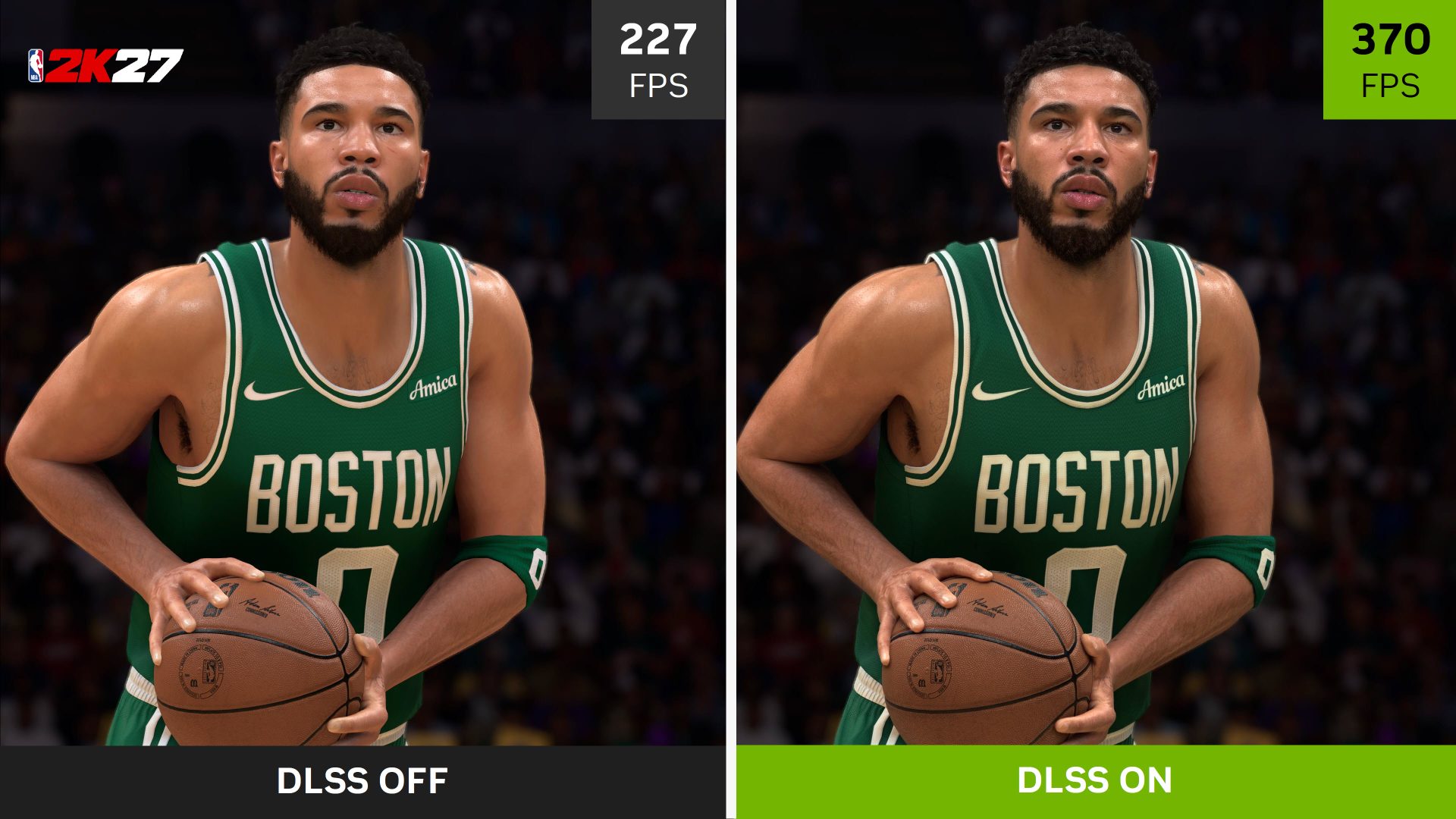
NVIDIA is sharing the first performance figures of its RTX 50 GPUs running DLSS 5, offering next-gen visuals at super-fast frame rates.
DLSS 5 Is Tuned For Games & NVIDIA Says That They Will Be Able To Make The New Model Run Faster, With The Progress Here Being Even Faster
So the first game to use DLSS 5 is NBA 2K27 & NVIDIA is showcasing the first performance results of its GeForce RTX 50 GPUs across their target resolutions.
Difference Between Native DLSS 5 Titles & Modded DLSS 5 Titles
But first things first, unlike what you’ve been seeing online, the developers will have control over what they want to change and what they want to uplift in terms of visuals within the game. This is for games with native DLSS 5 support.
What you’ve been seeing online is modders using developer tools to adjust DLSS 5 parameters to their own preferences. These may not be what the original artists or devs intended, but more of a personal/individual choice. Modding games will always be integral to the PC community, but you have to understand that the comparisons that are being shared online are not created by the original devs.
Games with Streamline will enable easy integration of DLSS 5, allowing developers to leverage the toolsets to make their games look better. So for end users playing native games, the toggle will be a simple On/Off. You won’t be able to set DLSS 5 parameters in games with native DLSS 5 titles, but there will be an option to customize and mod it, as there has been with various upscaling and frame-gen mods over the years.
All the controls that we showed during the presentations, the way we see it is that, again, these are developer controls. We’re developing, we’re creating them for the developers.
So, our intent is that they’re used by the different game devs to bring their artistic vision to life. And so, ultimately, when the players decide to play with DLSS 5 on, right, they know that they’re playing with whatever the original developer had intended them to play with, right?
Obviously, at the same time, if the developer wanted to create, for example, presets in the future and all of that, you know, that we cannot know or we cannot comment on that. But ultimately, our vision when we’re developing these tools, as you can see, they’re very dev-oriented. So, we’re creating them for people to make the game.
DLSS 5 on RTX 50 GPUs (1080p, 1440p, 2160p)
The testing was carried out with DLSS 5 enabled through the in-game settings, along with Ray Tracing On, Ultra Preset. All testing was done with Multi-Frame Generation enabled in 6x mode and DLSS Super Resolution set to Quality Mode.
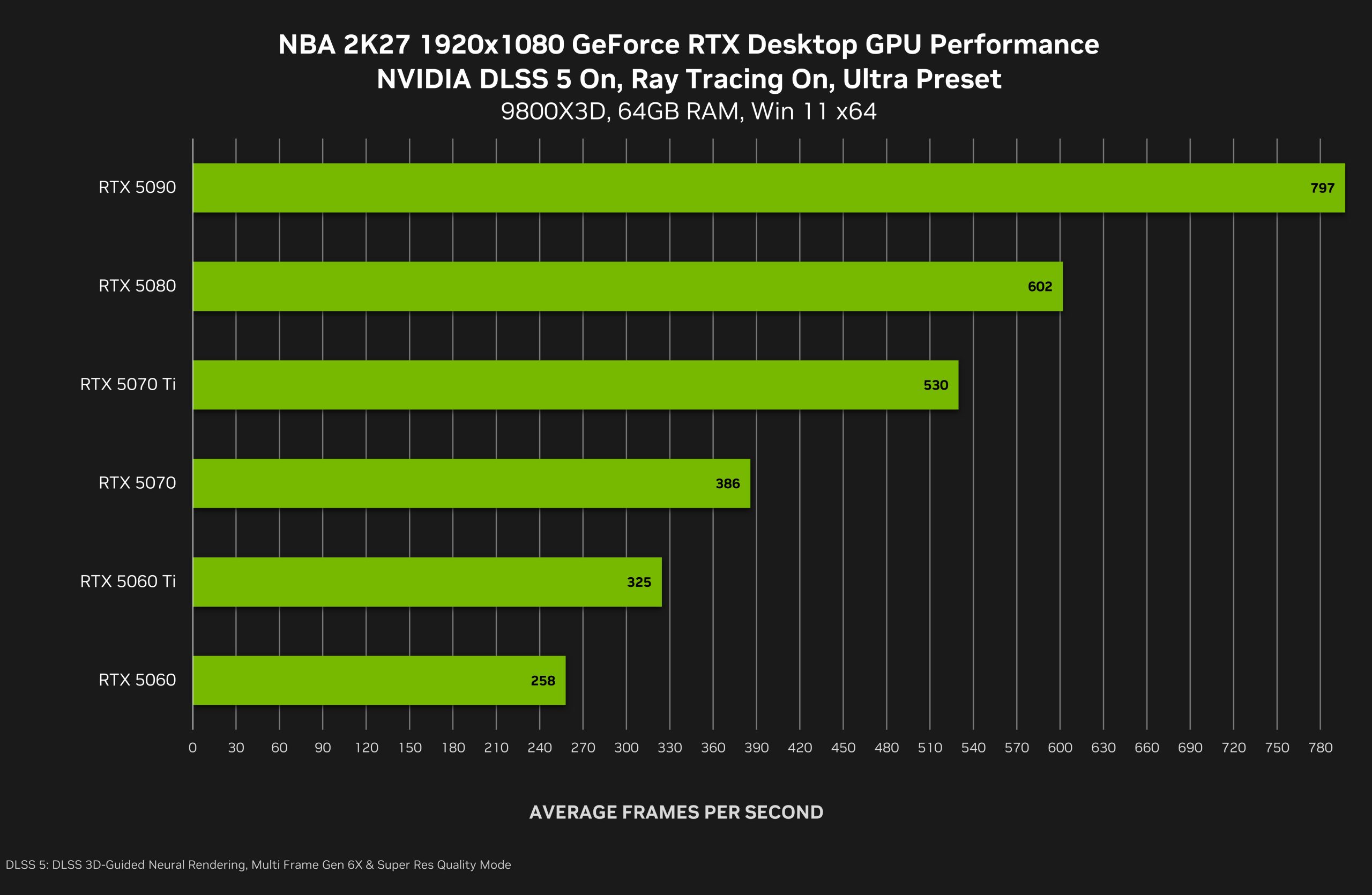
At 1080p, the entry-level RTX 5060 managed over 250 FPS while the rest of the stack delivered anywhere from 300+ to over 500 FPS. Now, while these are impressive figures, it looks like there might not be a need for MFG 6x mode at lower resolutions, unless you are running a crazy fast refresh rate display.
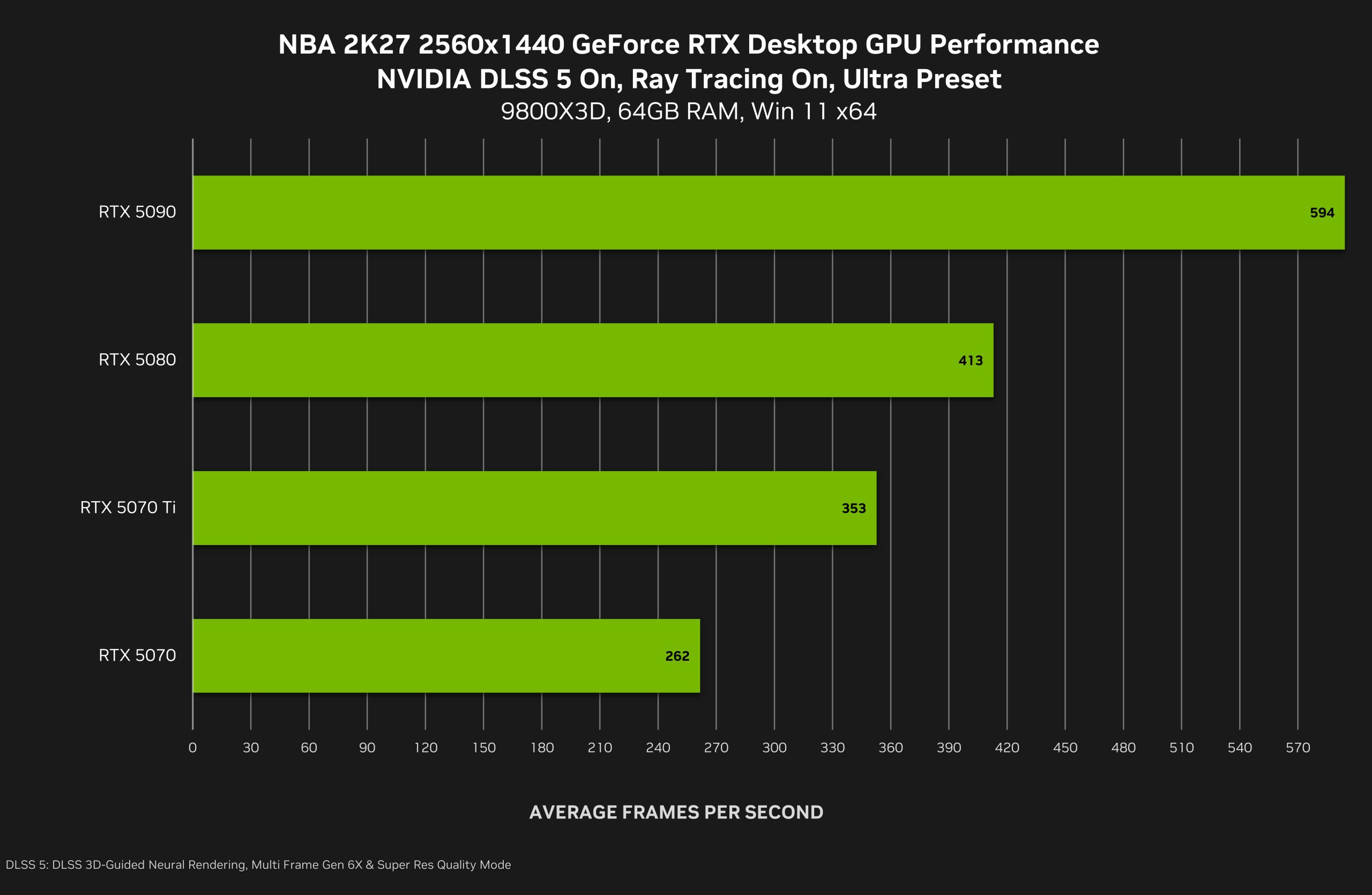
At 1440p, NVIDIA recommends RTX 5070 and above for DLSS 5 in NBA 2K27. Here, the RTX 5070 offers over 260 FPS while the RTX 5090 flies past 500 FPS.
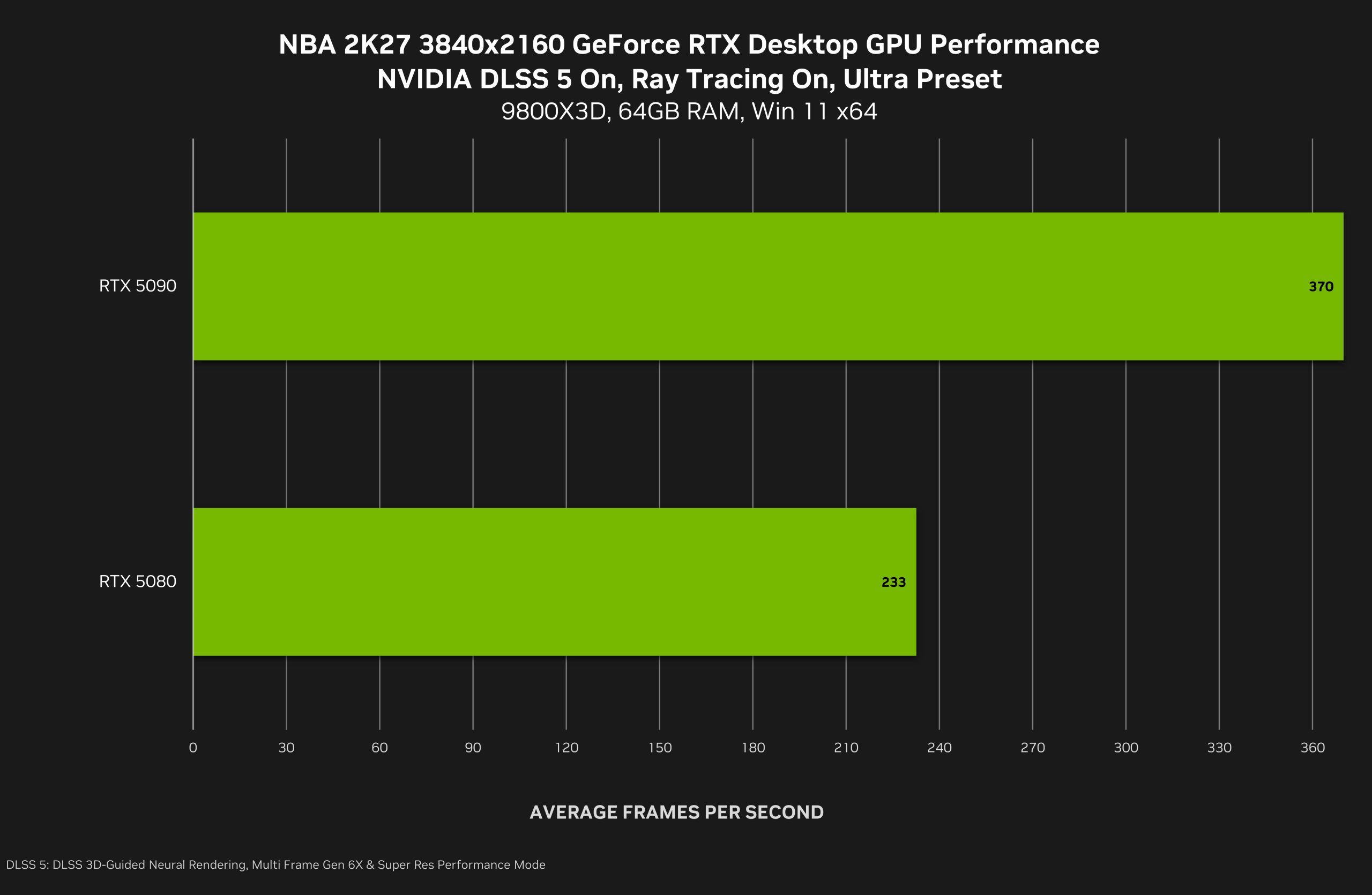
Finally, at 2160p, NVIDIA recommends its top-of-the-line RTX 5080 and RTX 5090 GPUs. The RTX 5080 offers 233 FPS on average at 4K, while the RTX 5090 delivers a crazy-fast 370 FPS on average. Once again, I believe we can tone down the MFG mode to 4x and still enable a decent 240Hz experience on the flagship.
The Performance Impact & RTX 50 Only Support (Officially)
But NVIDIA is terming DLSS 5 as their largest and most complex model to date, and the priority is to leverage the latest tensor core architecture on RTX 50 GPUs. The model itself is trained & runs on FP8, which is offered on both RTX 50 and RTX 40 series graphics cards, and while we have seen way older RTX cards running it, the base frame rate and the missing MFG technologies might not yield a playable or “adequate” experience within DLSS 5 titles. The model is also not NVFP4 Quant yet.


And despite that, the model has a 50-60% impact on performance on average. So that’s why you see the broad use of MFG modes across the RTX 50 family. But DLSS 5 is independent and can be enabled using the native raster renderer. It does not need any other DLSS technology to enable it as a prerequisite.
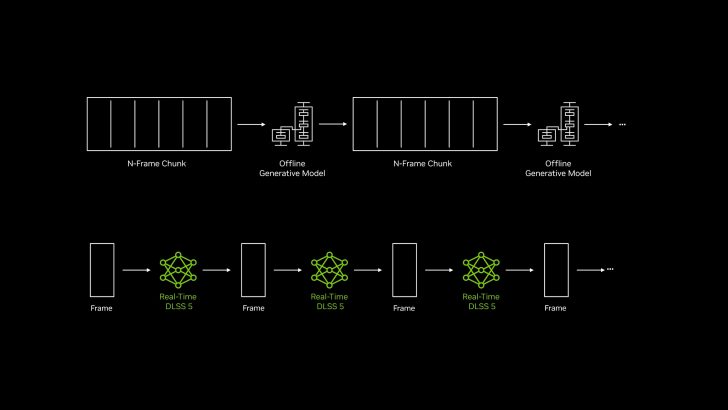
In terms of latency, DLSS 5 has no additional systematic impact like in frame generation, and it does not have to wait for the next frame. The extra latency comes from the model itself at the current frame.
We also asked NVIDIA if there was a performance penalty on the number of items or masks that can be applied by the developer, and the answer was “no difference in performance”. The model does not scale based on the value in the buffer. Also, the different DLSS 5 models (A, B, C) have no performance differences.
Optimizations Ongoing To Make DLSS 5 Even Faster
Moving to optimization, NVIDIA’s DLSS 5 has seen massive improvements since its first unveiling back at GTC in March 2026. The original demo was run on dual RTX 5090 graphics cards, but the company managed to improve the model by 50% within two months, managing to run it on just one RTX 5090.
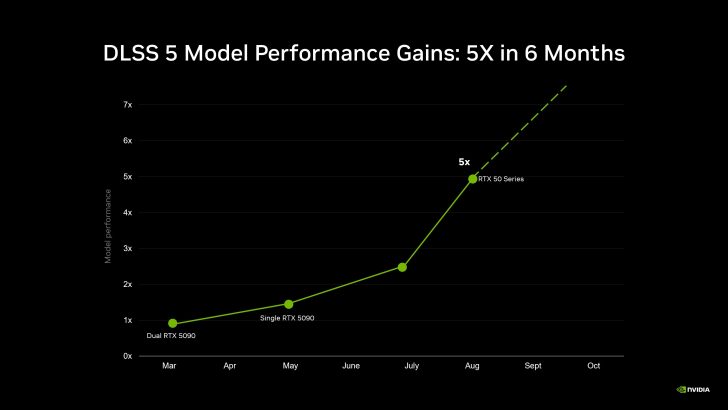
In July, NVIDIA got the DLSS 5 model to improve by almost 2.5x, and finally, in August, the model improved by 5x and is able to run across all RTX 50 graphics cards. NVIDIA explained that the improvement to the DLSS 5 model is a combination of basic hardware, software kernel, and co-design optimizations. The model is smaller, faster, looks more realistic, and offers more control to developers than the initial model that was presented during GTC 2026.
Furthermore, NVIDIA isn’t stopping here. The company says its optimizations for DLSS 5 will roll out at a much faster pace, making the model run faster and look even better. It looks like we’ll be able to get another update later this year that improves the model and brings faster performance to the table.
The Full DLSS 5 Q&A
Q – What is the impact of the technology on a rendered frame? Is there latency? And will it be calculated on the CUDA cores or the Tensor cores?
A – So, DLSS 5 runs on the Tensor cores. It leverages the fifth-gen Tensor core from the Blackwell series. And there is no additional systematic impact like in FG. It does not have to wait for the next frame. So, all the extra latency comes from the cost of the model itself at the current frame.
Q – While older RTX families may not have the compute to deliver a desirable experience in DLSS 5, will there be an option to run DLSS 5 on them regardless, like DLSS 4.5, Super Resolution, or Ray Reconstruction?
A – Yeah. DLSS 5 is our largest, most complex model just yet. It’s, you know, it’s a lot. And our priority and focus has been just for the RTX 50 series leveraging the latest Tensor core there.
Q – Is this a model that should be trained game per game, or is it possible to have a broad solution for gamers?
A – It is a general model. It’s a single model. Well, we’re providing multiple models in it, but those three models work across all the games that you’re integrating.
Q – Is there any point of using DLSS 5 on games that are not looking for realism?
A – So, yes, we’ve seen compelling results in games that are not for real. And again, because it’s very easy to integrate, if a developer wanted to add DLSS 5 to their game, they could, and they could see the results and judge for themselves. But ultimately, you know, the technology is obviously, as you mentioned, it’s the better the input, the better the output. So, you might see different results when the game strives for realism. But again, up to the developer and the artist to determine whether the technology aligns with their, you know, their artistic intent.
Q – Is there a performance on how many groups a developer defines to run on different styles of DLSS file?
A – So, no. So, you can have as many groups or as many items masked as you want with all the settings different, you know, per group or per mask. And there’s no difference at all in the performance compared to that.
Yeah, I’ll add something, right? What the model, how the model works is that it will take a screen space buffer. The buffer will specify all the console values that the developer created. They’ll put those values into this buffer. How they put those values in there, that depends on how the engine works. So, there might be some minor additional costs on how they create that buffer, but the model runs no matter the value that you put in the buffer. It’s not, does not scale based on the value in the buffer.
Q – Will DLSS 5 be backwards compatible with older games?
A – If developers choose to integrate DLSS 5 with older games, yes, it will work.The integration is pretty easy. It takes the color buffer and the motion vectors. So, games with streamline can be integrated, but it’s developer choice to integrate them.
Q – How will DLSS 5 interact with other AI technologies presented by NVIDIA, such as AI texture compression or Reflex 2?
A – Yeah, I just mentioned about Reflex. Reflex is like, it works after DLSS. It’s completely orthogonal. It’s fine. And for the AI textures, neural net texture compression is also completely orthogonal. That’s inside the renderer, right? DLSS is still, it works later on the screen space buffer. So whatever the renderer does is how we create that frame buffer in the first place. So it’s completely orthogonal.
Q – How much work do developers need to do creating metadata so that DLSS 5 can recognize what is foliage, furniture, metalware, etc., if they want different levels of DLSS 5 with different assets and objects?
A – So, this will obviously change by developer to developer how they implement it. And also, on the engine side, how they go about implementing it. They could decide to make it however they want, right? You could choose to do indoor, outdoor, or in-game play, cutscene, or go to per object if they want. And maybe it’s up to them. We view it just as a tool, just like for other rendering algorithms, they will have to do similar work to it to see how they view it in the best. This is just another tool.
Q – How does the architecture of DLSS 5 models fundamentally differ from transformer models used in DLSS 4 and DLSS 4.5?
A – Yeah, we’re not revealing the detail of the background, but what it does is fundamentally different.
All the previous DLSS reconstruct the image based on sparse input signals, and DLSS does generation. All the previous DLSS does have a ground truth that is correct, and that’s their target. That’s why it’s called reconstruction. DLSS 5 does not have a ground truth. The artist’s direction is the new ground truth. Therefore, we offer tools for artists to use it as an additional tool in the graphics pipeline to generate the image that they want and fulfill their artistic vision, free them from the existing compute and VRAM budget.
Q – How is DLSS 5 control exposed in the game? Anything beyond on and off?
A – So, as we mentioned, currently, in its form, it’s a tool for developers. So, when developers use all the controls that you’ve seen during the presentation, right, when the end user, when the gamers turn it on, they will see it exactly as the developers originally intended for them to look. This does not mean that in the future there might not be specific things like, for example, maybe presets that the developer creates. But again, ultimately, this is the choice of the developer to how the end users get to experience it.
With that said, NVIDIA DLSS 5 will be available on 3rd September in NBA 2K27. We will have a lot more to talk about in the coming days on this latest technology, so stay tuned.
About the author: A Software Engineer by training and a PC enthusiast by passion, Hassan Mujtaba serves as Wccftech’s Senior Editor for hardware section. With years of experience in the industry, he specializes in deep-dive technical analysis of next-generation CPU and GPU architectures, motherboards, and cooling solutions. His work involves not only breaking news on upcoming technologies but also extensive hands-on reviews and benchmarking.
Follow Wccftech on Google to get more of our news coverage in your feeds.
