

STONKBROKER is a community-driven project based on Robinhood Chain that combines memes with on-chain financial infrastructure.
What Is STONKBROKER?
The Idea Behind the Project
Instead of a meme coin, it is described as an ecosystem of NFT-based community participation tools, trading tools, liquidity tools, and token launch tools.
Officially, the protocol relies on a set of 4,444 NFTs integrated into several modules of the ecosystem.
For those asking what is STONKBROKER, it’s better understood as an early ecosystem protocol, rather than another speculative token.
Why STONKBROKER Was Built on Robinhood Chain
Robinhood Chain is an Ethereum-compatible Layer-2 blockchain for tokenized real-world assets, DeFi applications, and permissionless dApp development. According to Robinhood, it is EVM-compatible and uses ETH▲$1,761.17 as its native transaction fee token.
With STONKBROKER Robinhood Chain launch, the project would further establish itself as part of an emerging ecosystem that allows new protocols to find early traction, as well as utilize DeFi functionalities.
| Blockchain | Robinhood Chain |
| Category | Community-driven DeFi & NFT ecosystem |
| Token Standard | ERC-20 |
| NFT Collection | 4,444 NFTs |
| Wallet Standard | ERC-6551 token-bound accounts |
| Main Utilities | Trading, liquidity, marketplace, token launcher |
| Native Network Gas | ETH |
| Launch Type | Free NFT mint with community participation |
Key Features of the STONKBROKER Ecosystem
In addition to STONKBROKER token, official documentation describes other ecosystem components: token-bound NFT accounts, a decentralized exchange, liquidity pools, a marketplace, and a token launcher.
One of the project’s main features is NFT-based participation, in which each NFT has its own token-bound wallet and turns STONKBROKER crypto into part of a wider on-chain ecosystem with specific utility rather than simply a speculative token.
How Does STONKBROKER Work?
Token Utility and Community Incentives
According to its documentation, it is a multi-product DeFi ecosystem, rather than just a token; users can use the launcher, exchange, liquidity pools, marketplace, and covered-call module from the same interface on Robinhood Chain.
Community participation is associated with the ecosystem NFT collection, and STONKBROKER token functionality expands when additional protocol modules are implemented after the mainnet launch.
NFT Integration and Token Allocation
The project consists of 4,444 ERC-721 NFTs, each of which is paired with an ERC-6551 token-bound account. The official site notes that each NFT is generated with its own on-chain wallet for the purpose of holding tokenized items and interacting with apps in the ecosystem.
Who would have thought, we will see the biggest runner of this year not in Ethereum but on Robinhood 🤯
– Stonkbroker currently trading on 14M and floor price is 1.89 ETH that’s around 3.5k$
– I really think Stonkbroker might bring the liquidity back to the NFTs we are looking… pic.twitter.com/ijhqaiG9K5
— Known Xd (@0xKnownxd) July 20, 2026
These allocations are earned by burning a certain number of eligible NFTs from each of the supported collections prior to the free mint, an NFT-first approach that distinguishes STONKBROKER from customary token drops.
Trading Through Robinhood Chain DEXs
According to the documentation, token swaps happen on a Uniswap V3-based market on Robinhood Chain. The protocol also supports wrapping ETH, routing, and on-chain token discovery
This architecture also allows Robinhood Chain tokens to be supported by the existing infrastructure of decentralized exchanges and the EVM environment present on the network.
Liquidity and Token Distribution
Liquidity was planned to be managed by separate contracts, and documentation exists for creating and managing Uniswap V3 liquidity positions natively within the protocol and for launch contracts that could have automatically created liquidity pools after the conclusion of a token sale.
Officially, there is no set public sale, with the new Robinhood Chain token being distributed through the NFT mint, whitelist allocations, and ecosystem participation following the launch.
Why STONKBROKER Skyrocketed 167% in Just 24 Hours
Robinhood Chain’s Explosive Growth
This was coupled with rising activity on Robinhood Chain, a blockchain Robinhood had recently launched and marketed as an Ethereum-compatible Layer-2 chain focused on DeFi and tokenized assets. Activity quickly rose on the chain with the launches of new applications and meme tokens.
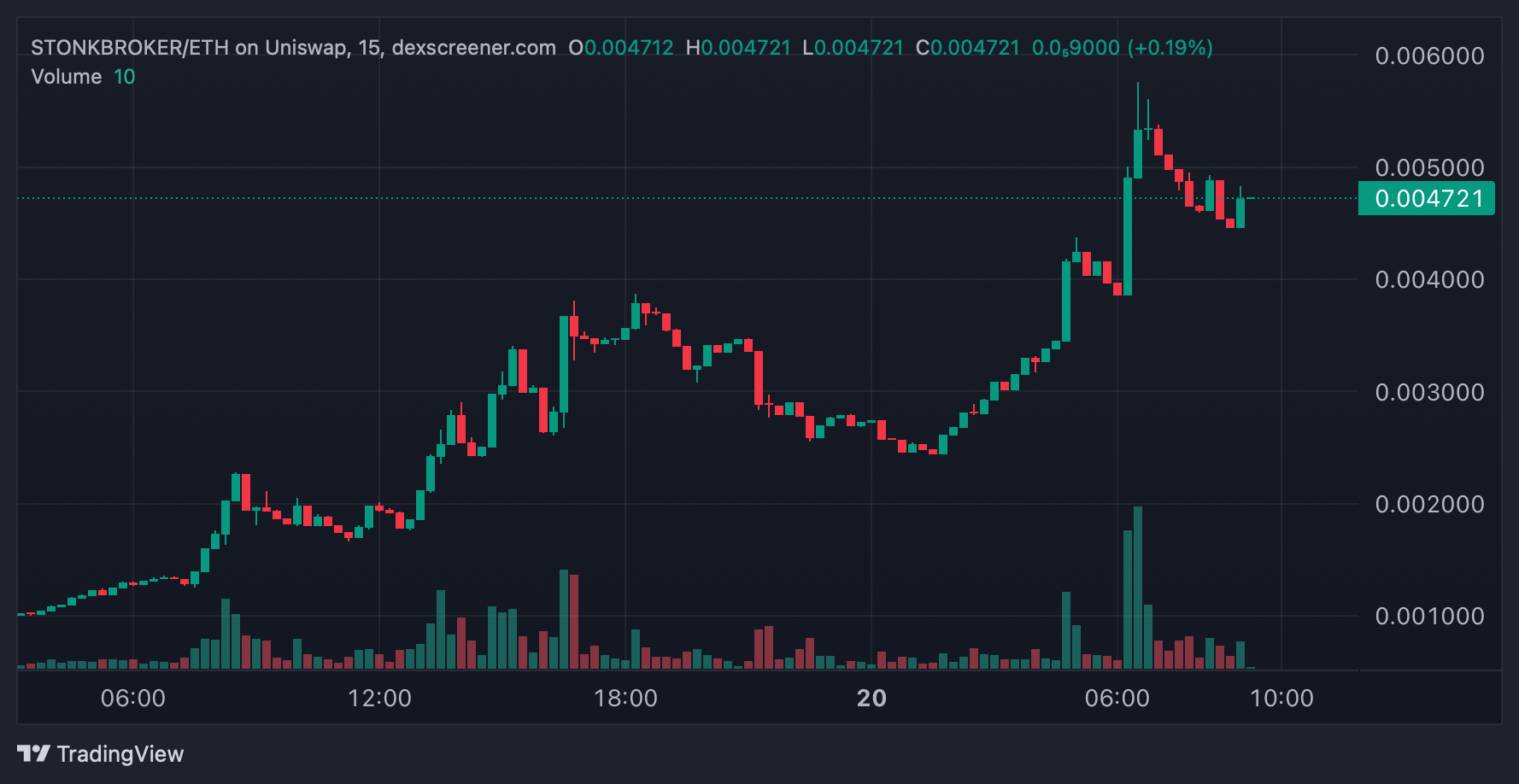
Robinhood Chain saw a brief rise in daily DEX volume in the first few weeks of operation and, at times, saw more daily DEX volume than several of the major chains as traders sought early Robinhood Chain tokens.
Rising Trading Volume and Liquidity
Market data suggests that STONKBROKER price rise was accompanied by a large increase in trading volume. On CoinGecko, STONKBROKER trading volume exchange in the last 24 hours was more than $2.4 million, with the majority on the Uniswap V4 deployed on Robinhood Chain.
The presence of additional liquidity makes it easier for traders to enter and exit positions and adds to short-term momentum.
Community-Driven Momentum
Project announcements, including the free NFT mint and the ecosystem’s ERC-20 token, garnered massive community interest on social media, with the focus being on NFT holders, token distribution and upcoming DeFi products rather than a customary token sale.
This also brought a lot of attention to STONKBROKER news, and the project was riding the wave of excitement around Robinhood Chain’s ecosystem growth.
Speculation Around Early Robinhood Chain Tokens
Speculation is common with blockchain networks at the early stages as traders seek to identify which tokens could become the dominant application on the network. This has occurred on Robinhood Chain, where some newly created tokens have seen high trading volume.
There are many investors asking why is STONKBROKER pumping and why is STONKBROKER up today, there is no confirmed catalyst at this time.
Available market data suggest that this rally was supported by increased network activity and liquidity on the network and the high levels of speculation in Robinhood Chain’s new assets.
Why Robinhood Chain Is Fueling New Crypto Narratives
Mainnet Launch and Builder Adoption
Robinhood Chain publicly launched its mainnet on July 1, as an Ethereum Layer-2 utilizing Arbitrum technology.
The chain was focused on tokenized real-world assets and DeFi. Launch partners included Uniswap, Alchemy, BitGo, Chainlink, and Pleiades. Robinhood marketed the chain as a permissionless space for developing financial applications.
The company has supported ecosystem development through developer tools, EVM compatibility, and tokenized stock support, and has developed an interest in the best Robinhood Chain projects in the early stages of the network.
Growing DeFi Infrastructure
Features such as decentralized exchanges, lending, and cross-chain services are supported as core DeFi primitives of Robinhood Chain. ETH was implemented as the chain’s native gas token, and infrastructure is supported by services such as Chainlink and Alchemy.
🚨 If this gets officially confirmed, we could be looking at something historic.$STONKBROKER could become the first NFT ecosystem of its kind to reach a CEX.
Why?
Because 666,666 $STONKBROKER represents one StonkBroker NFT.
It’s a completely different structure from a… pic.twitter.com/d5dMsp6KyA
— ForseSi.moca (@AcquaRagia93) July 20, 2026
This continues to make it easier for developers to launch Robinhood Chain tokens, giving early projects liquidity and Ethereum tooling on day one.
Why Early Ecosystem Tokens Are Attracting Traders
Similar to most new blockchains, Robinhood Chain attracted short-term speculative interest as traders looked to get in early on first-mover advantages from projects and assets. This can be seen in increased activity on-chain.
Interest in meme coins and experimental DeFi protocols generated media attention in the early days, as several of these projects went live shortly after the mainnet launched.
The Impact of Tokenized Assets on Network Activity
Robinhood built the network to ease tokenization of stocks and ETFs traded 24/7 on-chain, integrated with DeFi applications, linking customary financial assets to decentralized technology in a single Layer-2 ecosystem.
With a greater number of tokenized assets available, developers anticipate that there will be greater opportunities for lending, liquidity, and collateralized trading in Robinhood Chain applications.
| Why Robinhood Chain Is Gaining Attention | Impact |
| Layer-2 Architecture | Lower-cost Ethereum-compatible transactions |
| Tokenized Assets | Supports onchain stocks, ETFs, and RWAs |
| DeFi Infrastructure | Enables DEXs, lending, and liquidity services |
| Developer Ecosystem | EVM compatibility simplifies deployment |
| Early Network Stage | Creates opportunities for new projects |
| Institutional Partnerships | Backed by major blockchain infrastructure providers |
| Growing Activity | Rising adoption of applications and ecosystem tokens |
STONKBROKER Tokenomics Explained
Total Supply and Distribution
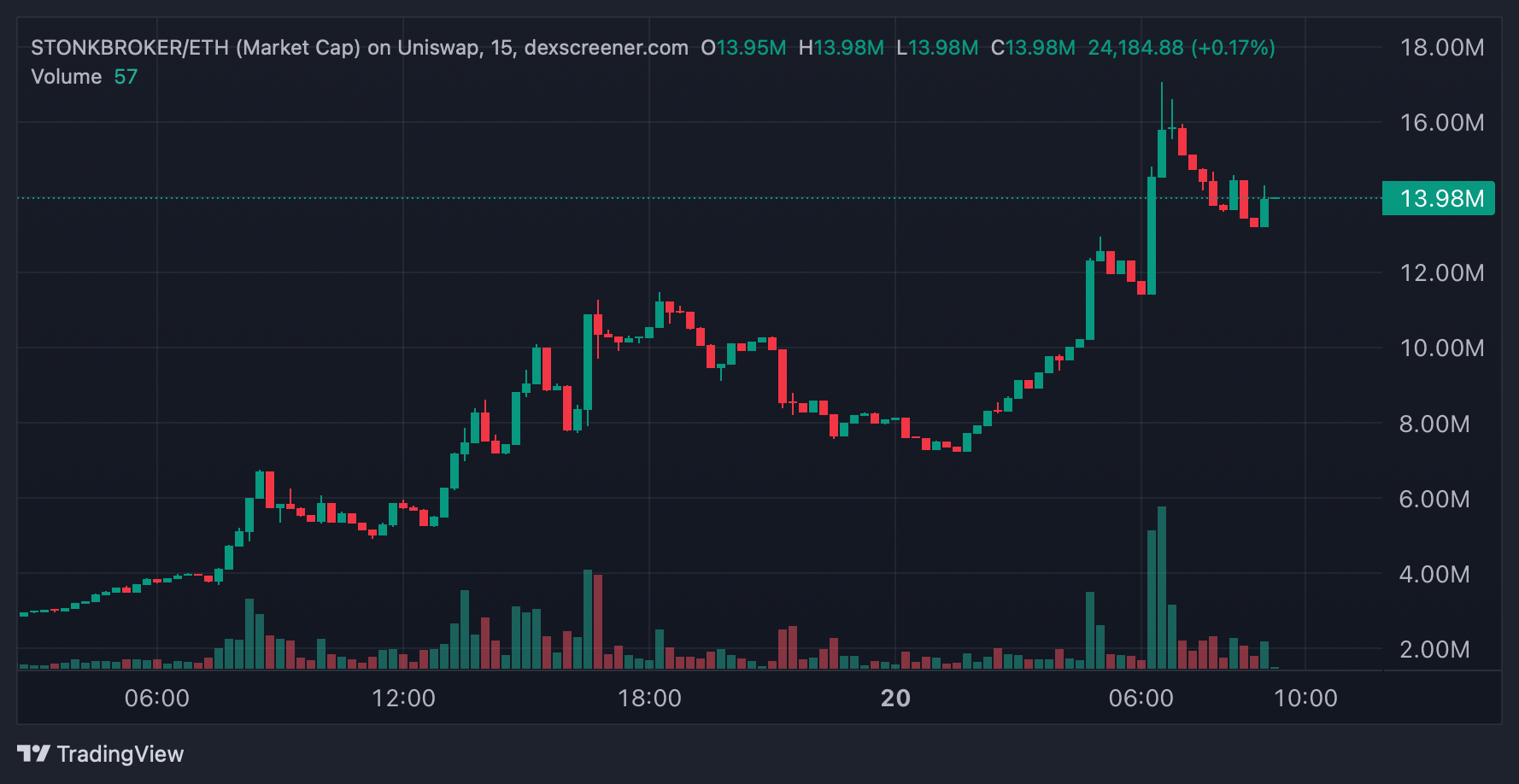
Current market data places STONKBROKER market cap at approximately $12.5 million, matching its fully diluted valuation, while on-chain liquidity stands at around $1.8 million. These figures indicate that the token has established an active trading market despite its recent launch.
According to the project’s documentation, ecosystem participation is centered around a free mint of 4,444 NFT characters on Robinhood Chain.
The protocol also allows creators to configure ERC-20 launch parameters—including total supply and token allocation—when deploying new tokens through its launcher, rather than relying on a fixed ecosystem-wide model.
NFT-Based Token Allocation Model
STONKBROKER is an NFT-first allocation. Mint allocations for eligible holders of supported NFT collections were granted upon burning before the free minting started. Each NFT has a corresponding ERC-6551 token-bound account that stores assets on the blockchain.
The aim is to make NFT ownership a central mechanism for engagement, separate from the conventional public distribution of tokens.
Liquidity Strategy
According to the documentation, the protocol’s launcher expects to finish token launches by making a Uniswap V3 liquidity pool and minting a liquidity provider position. Concentrated liquidity pools on Uniswap V3 are supported in the ecosystem and available for users to manage on Robinhood Chain.
Other tools to incentivize long-term use of capital include LP positions and covered-call functionality.
Long-Term Sustainability
The roadmap envisions scaling usage of the protocol itself through products such as a marketplace, token launcher, exchange, liquidity management, and options infrastructure, not just by speculating in the token.
With a number of components already built, the ultimate success of the ecosystem relies on user adoption, liquidity, and the successful execution of its roadmap.
What Makes STONKBROKER Different From Other Robinhood Chain Tokens?
Community-First Launch
STONKBROKER project differs from others considerably relying on a public sale for the token launch. The main minting event is designed to be a free mint of 4444 NFTs. Users can obtain whitelist spots by burning NFTs from partnered projects. It is focused on building community before the project gets underway, rather than raising funds.
Onboarding however, is different than other new Robinhood Chain token launches (typically through a token sale or liquidity event) because of the NFT-first nature of Chapter.
Integration With the Robinhood Chain Ecosystem
It is native to Robinhood Chain, utilizing Uniswap liquidity pool, token registry, and other Robinhood ecosystem services. Furthermore, Robinhood markets the network as a permissionless Layer-2 for developers to build financial applications on the network.
🚀 TRENDING: $STONKBROKER is gaining attention with its unique NFT-Fi narrative.
The project combines token-bound NFTs with tokenized stock rewards, bringing together NFTs and real-world assets in a novel way.
As tokenization continues to grow, narratives like this are… pic.twitter.com/ftp7108haI
— Shivay (@CryptoShivay) July 20, 2026
This close alignment makes STONKBROKER one of the few projects that build on the chain’s native tools rather than merely bridging an existing token.
Meme Culture Meets On-Chain Infrastructure
According to the project’s own documentation, alongside the name honoring an internet meme, the protocol is comprised of a token launcher, a decentralized exchange, a marketplace, and liquidity and covered-call functionality.
Instead of hype, the ecosystem is described as a mix of community-driven branding and functional DeFi infrastructure using Robinhood Chain technology.
Early-Mover Advantage
Similar to many new blockchain ecosystems, projects being built on Robinhood Chain often garner a lot of attention, as Robinhood Chain is still in its early stages, with developers deploying new applications and users trying out the new ecosystem.
That environment has increased the popularity of the best Robinhood Chain projects, as traders look for protocols that could benefit from future network adoption.
| STONKBROKER Highlights | Details |
| Launch Approach | Community-first NFT mint |
| Network | Native to Robinhood Chain |
| Infrastructure | DEX, liquidity pools, marketplace, token launcher |
| NFT Technology | ERC-6551 token-bound accounts |
| Community Access | NFT whitelist model |
| Market Position | Early ecosystem project |
| Primary Focus | Meme branding combined with DeFi infrastructure |
Risks Investors Should Know
Extreme Price Volatility
Similar to other newly launched ecosystem tokens, STONKBROKER price has been extremely volatile since launch. As seen on CoinGecko, STONKBROKER achieved a new all time high (ATH) very shortly after launch, showing the extreme volatility and quick changing of market sentiment that can occur in newer tokens.
Such volatility can lead to opportunities, but can also mean pronounced corrections for investors during the price discovery process.
Low Market Capitalization
Public STONKBROKER market cap data is incomplete because the circulating supply has not been reported to data aggregators. CoinGecko lists the fully diluted the token valuation, but does not yet track its market cap.
When there is no easy way to establish circulating supply, it can be more difficult to assess the project’s valuation relative to other crypto-assets.
Liquidity Risks
Though daily trading volume has increased since the token’s initial release, the majority of that volume is still concentrated on a single decentralized exchange and trading pair, which may also lead to exaggerated price fluctuations with decreased volume.
Similar to many early DeFi projects, low liquidity can lead to potentially high slippage for large trades.
Ecosystem Execution Risk
There are other intended STONKBROKER features, such as DeFi and a marketplace, which have not yet been implemented. Long-term STONKBROKER success may hinge on the execution of such features and the continued activity of users.
Robinhood Chain itself is still in its early stages of ecosystem development and is exposed to the execution, adoption, and infrastructure risks of a maturing blockchain.
Can STONKBROKER Sustain Its Rally?
Bullish Catalysts
Robinhood Chain’s growth may be the most immediate motivation for adopting it, but its expansion of DeFi protocols and user base may present an opportunity for even higher trading volume and liquidity.
Robinhood characterized the chain as a long-term platform for asset tokenization and decentralized finance, with STONKBROKER as one of the first ecosystem projects for the chain.
Another positive sign of success is sustained interest in the market, as CoinGecko reports the continued existence of multi-million dollar daily trading volumes of the token long after its launch date.
Bearish Scenarios
The recent rally, with newly launched coins having no circulating supply and thus no market price, shows how, in response to speculation, price increases can become very large, and meaningful selling pressure can occur after speculation, crashing prices.
Execution risk is also present, given that the success of the ecosystem described in the documentation is heavily reliant on its execution, as well as continued Robinhood Chain adoption.
Key Metrics to Watch
In summary, tracking factors such as the daily trading volume, volume adjusted depth, new wallet activity, protocol development updates, and fully diluted valuation as reported by market data aggregators may be more useful instead of relying on STONKBROKER price prediction.
For STONKBROKER price, onchain activity and liquidity going up, and trading volume and ecosystem adoption going down would be positive and negative indicators, respectively.
How to Buy STONKBROKER
Setting Up a Compatible Wallet
An EVM-compatible wallet can be used to access Robinhood Chain. The chain has a native wallet called Robinhood Wallet. Other EVM wallets can connect with Robinhood Chain by adding Robinhood Chain network configuration manually. The base gas currency for the network is ETH.
To purchase STONKBROKER, users must be connected to Robinhood Chain and must have enough ETH to cover transaction fees.
Bridging Assets to Robinhood Chain
Assets on Ethereum and other supported chains can be bridged onto Robinhood Chain, preferably through Robinhood’s canonical bridge; other supported bridges include Across, Relay, LayerZero/Stargate, Chainlink CCIP, and LiFi.
from free mint to 2 eth in 2 days on @RobinhoodCrypto and listing on a cex on 2nd day. whats now on the roadmap?
according to docs there are 3 more unreleased layers that are not dependent on the current volume loop:
> phase 2 – token launchpad
> phase 3 – vote-directed DEX
>… https://t.co/2Iyd7Upzsxpic.twitter.com/7udBFzmsoc— Max (@MaxVoshchansky) July 20, 2026
This duration varies between bridges, but a typical deposit time in the canonical Ethereum-to-Robinhood Chain bridge is around 10 minutes.
Buying STONKBROKER on a DEX
Once you send funds to Robinhood Chain, you can connect your address to a DEX that is compatible with the network. The project claims it uses Uniswap V3 structure to trade ETH and other assets for STONKBROKER token.
It is also important to double-check the expected slippage, network fees, and the official token contract deployed by the project before proceeding with any transaction.
Storing Your Tokens Securely
After completing how to buy STONKBROKER tutorial, the tokens will be in your self-custodial wallet until you choose to send them elsewhere. Back up your recovery phrase! Don’t share your private keys!
For larger amounts, hardware wallets that support EVM compatible chains can be used to hold funds while still being able to interact with decentralized applications on Robinhood Chain.
What Is STONKBROKER?
STONKBROKER is a community-oriented NFT and DeFi (decentralized finance) project on Robinhood Chain. It consists of tools for launching tokens, trading, and managing liquidity, and a marketplace. Its 4,444 NFT collection contains token-bound accounts built with the ERC-6551 standard.
Why Did STONKBROKER Rise 167%?
The price spike coincided with increases in Robinhood Chain usage and trading volume soon after the launch of the project. Data suggests the price spike was due to increased liquidity and speculation.
Is STONKBROKER an Official Robinhood Token?
No. There is no indication from Robinhood that STONKBROKER is a company-issued token. According to its community, it is deployed on Robinhood Chain.
Where Can You Buy STONKBROKER?
The token is traded on decentralized exchanges on Robinhood Chain, with the primary trading venue being Uniswap V4, according to analytics aggregator CoinGecko.
Is STONKBROKER a Meme Coin or a Utility Token?
The project uses meme branding and tools from decentralized finance (DeFi); NFTs, liquidity tools, a marketplace, and a token launcher are described in the project documentation.
What Are the Biggest Risks of Investing in STONKBROKER?
Price volatility and relative illiquidity compared to larger assets are among the main risks, along with the nascent nature of the ecosystem developing products, and attracting users.
